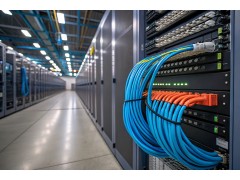


1. The "Data Arteries" of the AI Era: The Logical Reconstruction of Integrated Wiring
As AI models scale from the billion-level to the trillion-level, the demand for computing power and data transmission is growing at an unprecedented rate. Whether it's a smart data center or a smart building, its underlying network architecture is undergoing a "bandwidth revolution." The traditional wiring system dominated by gigabits can no longer support the requirements of high-density computing and low-latency interaction in the AI era, and the integrated wiring system is facing a complete technological restructuring.
The future of the wiring system will present three major core trends:
-
High-speed and low-latency: From 10G, 40G, 100G to 400G and even 1.6T, fiberization has become the mainstream trend in the core and backbone layers, achieving higher bandwidth and lower energy consumption, while copper cables continue to be optimized and coexist in the end access layer;
-
Full-light Interconnection and Intelligent Sensing: Building a "full-light building" network to achieve lossless transmission and precise control from the device end to the cloud;
-
Smart Operation and Maintenance and Visualization Management: With the help of electronic tags, AI diagnosis, digital twin, and other technologies, dynamic monitoring and automatic maintenance of network resources are realized.
Industry experts point out: "AI is not creating new buildings, but is reconstructing the nervous system of architecture." Integrated wiring is no longer just a "transmission channel", but a "data artery" that supports the building's intelligent computing capabilities and self-evolution capabilities.
This trend is driving the industry to accelerate innovation. New generation of technology solutions such as high-density MPO fiber connectivity, low insertion loss components, and intelligent monitoring modules are continuously maturing, providing efficient, secure, and scalable interconnection capabilities for smart computing centers. Meanwhile, the implementation of F5G (Fifth-Generation Fixed Network) standards is making the concept of "full optical interconnection" a reality, building a solid underlying support for AI computing power networks.
From high-speed interconnection to intelligent sensing, from physical connection to smart empowerment, integrated wiring is becoming an indispensable infrastructure in the AI era — it connects not only devices but also the intelligent potential of future buildings.
II. Smart Computing Centers成为“New Blue Ocean”: From Infrastructure to Strategic High Ground
The AI era's "power plant" is the smart data center, which far exceeds traditional IDCs in terms of energy consumption density, data traffic, and operational complexity. Wiring, as the core link of its data highway, is becoming a competitive focus.
According to industry forecasts, China's smart computing center market size is expected to exceed 100 billion yuan by 2028. Among them, the investment in integrated wiring and network connectivity is expected to exceed 15%. This is not only an upgrade in engineering technology, but also a restructuring of the industrial chain.
A wiring company centered on fiber technology is accelerating the layout of high-density, upgradable solutions, such as MPO/MTP multi-mode connectors, low insertion loss fiber components, intelligent distribution frames, etc. At the same time,the integration of visualization and intelligent operation and maintenance systemsis transforming wiring systems from "static assets" to "dynamic services", helping smart computing centers achieve "self-aware, self-diagnosis, self-optimization" intelligent management.
Three, from "connection" to "enabling": AI reshapes the building intelligence ecosystem.
With the mutual penetration of smart computing centers and smart building technology, the value of integrated wiring is shifting from "backstage facilities" to "front-stage capabilities". In AI-driven smart building scenarios, the value of wiring is being redefined. From energy systems, lighting control to security monitoring, data is no longer isolated, but coordinated through a unified network infrastructure across multiple scenarios.
In the field of intelligent building, integrated wiring has long since gone beyond the construction of information channels, but is developing towards the direction of "platform, intelligence, and ecology". With the deep integration of AI and IoT, various subsystems of the building (lighting, security, air conditioning, energy consumption, etc.) need to achieve real-time data interaction and unified control, which puts forward higher requirements for the architecture, standards, and security of the wiring system.
The future wiring system will be equipped with self-identification, self-diagnosis, and self-optimization capabilities. With embedded chips and intelligent monitoring technology, the system can detect network load and connection status in real-time, achieving "visual operation and maintenance" and "predictive maintenance". This not only enhances operational efficiency but also provides data support for energy-saving operation and carbon emission management of buildings. For enterprises, this means a new phase from "static connection" to "dynamic empowerment".
We expect that future construction will present a trend of "three-in-one integration":
-
Digital Twin: Each node of the building has data mapping, achieving real-time visualization and intelligent decision-making;
-
Edge Computing: Moving computing power to the device side to reduce response latency and improve energy efficiency;
-
System Coordination: Intelligent lighting, energy management, and security systems are deeply integrated on a unified network platform.
These trends will drive the intelligentization of buildings from "automation" to "cognitive", from single system intelligence to full-scene collaborative intelligence.
IV. Focusing on the Industry Cutting Edge – CIBIS 2025 Beijing Station is about to Unveil
As one of the most influential annual events in the field of intelligent construction in China,The 26thChina International Building Intelligence Summit (CIBIS 2025)Beijing Stationis scheduled to be held onNovember 18that the
This summit will focus on " The New Order of Intelligent Construction Driven by AI and Smart Computing", focusing onFull-Optical Interconnection, Smart Computing Infrastructure, Green and Low-Carbon BuildingsThree major directions. At the same time, experts from leading companies such asDetwiler, Tongfang, Commscope, and YinlanWill share the latest smart computing wiring technology and the application practice of building neural network architecture on-site.